Adding IDS Rules Export
To add a new IDS Rules export, follow the below steps:
Navigate to the “Exports” tab by clicking on the “Settings” link in the sidebar.
Click on the “Exports” tab.
Click on the “Add Export” button.
Enter the export name, this name will be used to identify the export in the exports list.
Select the export type, in this case select “IDS Rules”.
Select the export format, IDSTower supports exporting IDS Rules in two formats:
Text format, which is the standard Suricata/Snort IDS Rules format.
STIX 2.1 format, which is a JSON format used in TAXII-based Threat Intelligence Platforms.
In this guide, we will select the “Text” format.
Choose the IDS Rules Transformation settings that you want to be applied to this export, you can either use the default settings (can be found under Settings -> Rules) or customize them for this export.
For this guide, we will use the default settings.
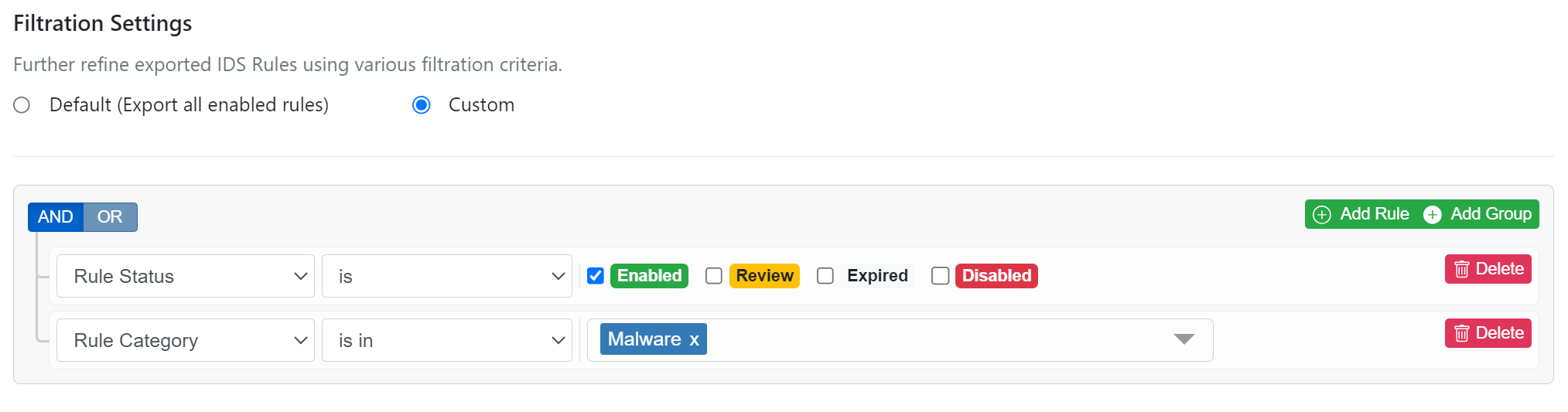
Choose the IDS Rules Filtration settings that you want to be applied to this export, you can either use the default settings (Exporting all enabled IDS Rules) or customize them for this export.
For this guide, we will use custom settings to export only the rules that are in the “Malware” category.
A rule’s action and its priority each have three filter fields. Once you select one in a filter row, the line under the row says what it matches:
Rule Action (Applied) and Rule Priority (Applied): the value IDSTower deploys, your override where you set one on the rule, otherwise the value in the rule text.
Rule Action (Rule Text) and Rule Priority (Rule Text): the value the rule text says, whether or not you override it. A rule whose text has no
prioritykeyword has no priority here. Before 3.2.0 these fields searched the rule text forpriority:N;instead of reading the priority IDSTower parses from the rule, so a saved filter can select a slightly different set where the two disagree: for example, a rule whoseprioritykeyword comes before amsgthat containspriority:1;no longer counts as priority 1.Rule Action Override and Rule Priority Override: only the value you set on the rule. Choose is set to export the rules you changed, or is not set to export the rules that follow their text.
A rule with no value in the field, because it has no override or its text has no priority, counts as “doesn’t equal” and “is not between” any value, and never as equal to, greater or less than one. For example, Rule Action Override “doesn’t equal”
dropalso exports the rules with no action override; add a Rule Action Override is set row to leave them out.Set the export’s Authentication Key. IDSTower fills in a random key, which you can keep or replace: the “show”, “copy” and “regenerate” links next to the field display, copy or replace it. A key you enter yourself must be 12 to 256 characters long and contain only letters, digits,
-and_.The key becomes the
authKeyparameter of the export URL, so every system that downloads the export needs it. If you change the key later, the old URL stops working.Click on the “Add” button to save the export.
Now you can see the newly added export in the exports list.
Click on “view” link under “Export URL” Column to view the exported IDS Rules, now you can use this URL, which includes the authentication key, to download the IDS Rules file in any Suricata instances. See Export URL for the URL format and the error responses.
Note
The export might take some time to generate, depending on the number of IDS Rules and the transformation settings, once it is generated, it will be cached and served instantly until the IDS Rules or the export change. Append
&disableCache=trueto the URL to force a fresh file, see Caching.Note
On a Standard license the export contains at most 10 IDS Rules. In the Text format, the comment line at the top of the file says so when the limit was reached.
Note
You can disable the export with the toggle switch in the “Status” column: switch it to “Disabled” to stop the export from being generated and served (requests to it are refused with HTTP 400), and switch it back to “Enabled” to serve it again.